History of the Lordship of the Manor
k
Ulting Manor lies in the parish of the same name a few miles south of Hatfield Peverel and on the north bank of the River Chelmer. The earliest record for the Manor comes in the Domesday Book which notes that before the Norman invasion it had been the property of Hacen. After 1066 it was given to Ralph Baynard. It was a prosperous manor recorded as being worth £4.
During the reign of Henry, I (1100 – 1135) Ulting was stripped from Baynard’s grandson, William, after he had supported a rebellion of Robert, Duke of Normandy in 1101. Baynard was one of the few Anglo-Norman barons who supported the duke and paid a heavy price. The Baynard's are perhaps most remembered today for building Baynard Castle, in County Durham.
Henry granted Ulting to Robert Fitz-Gilbert, founder of the line which became the Earls of Clare. It is likely that Fitz-Gilbert was the overlord of Ulting since by the reign of Henry II (1154 – 1189) the manor complex was held by William de Ulting, perhaps a descendant of Gerrard, who was recorded as holding the Manor from Ralph Baynard in 1086. The Ulting's were likely the class which became known as the landed gentry. Consequently, very little is recorded of the family, save that they held Ulting by Knight’s fee. In 1320 John Ulting succeeded to the manor and it is noted that he held it from Robert Fitz-Walter by payment of 3 shillings and the Prior of Beeleigh Abbey for the same amount. The demesne tenure in Essex, it is likely that he had a number of feudal tenants.
Within a few years however, the De Ulting family had lost their titular estate. How this happened is not known but there are a couple of reference in the Chancery records of John De Ulting being prosecuted as a debtor in the middle of the 14th century, so it seems likely that the family ran into financial trouble and were forced to sell.
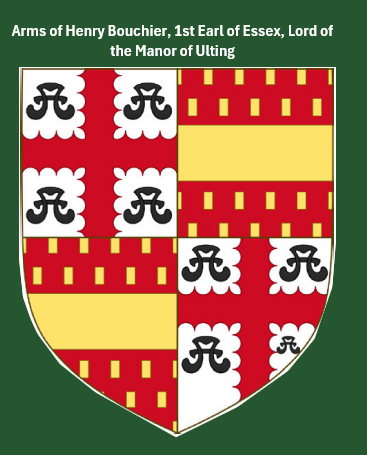
By the 1340s the Manor was the property of Robert Bourchier or Bouchier. The Bouchier family were of Norman descent and settled in Essex soon after the Conquest. By the reign of Edward II (1307 – 1327) John Bourchier of Colchester had been knighted and served as one of the Justices of the Kings Bench. His son Robert was a great favorite of Edward III and was made Lord Chancellor in 1340., at a fee of £500 per year. Bourchier was the first layman to hold this position, ousting Archbishop Stratford. In the struggle between the King and the Archbishop which followed. Bourchier withheld the writ of summons to Stratford, interrupted his address to the other Bishops in the Painted Chamber of Parliament, and urged him to submit to the King. Bourchier fought with notable distinction at the Battle of Crecy in 1346 where he served under the immediate command of Prince Edward, the Black Prince. He was created Baron by Writ of Summons in 1342 and was succeeded by his son John on his death in 1349.
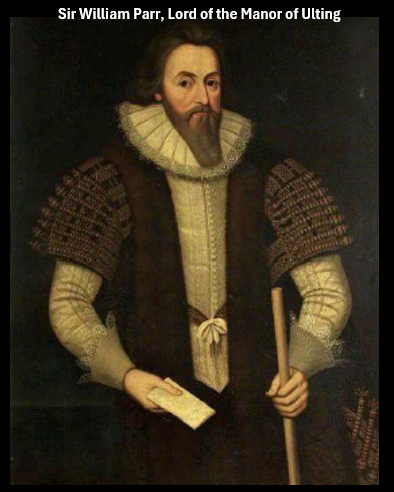
The family remained Lords of Ulting until the death of Sir Bartholomew in 1409. On his death his estate passed to his daughter, Elizabeth and so her Husband. Sir Hugh Stafford. He was summoned to Parliament as Lord Bourchier by Henry V. He died childless in 1421 and Ulting reverted to the Bourchier family. Henry, Earl of Essex, dies holding the manor in 1483 and was succeeded by his only daughter, Anne who was married to Sir William Parr. Parr was the only brother of Catherine, the sixth and final wife of Henry VIII. He was the son of a Lancashire courtier and came to the attention of the king after his success in the suppressing of the great Northern uprising in 1537 known as the Pilgrimage of Grace. He became a member of the privy chamber and in 1543, a few weeks after his sister had married King Henry VIII, he was created Earl of Essex, in honour of his father-in-law. After Henry’s death and the accession of Edward VI in 1547, Parr became one of the most important men at court and was known as the king’s ‘beloved uncle.’ He was the leader of the Protestant party in Edward's regime and held a series of positions including Lord Great Chamberlain (1550 – 1553). After Edward’s death in 1553, Parr and his second wife, Elizabeth Brooke moved to have Lady Jane Grey placed on the throne instead of Mary but after the failure of this plan he was arrested and convicted of high treason. Although he was sentenced to death, he was released only a few months later, but his estates had been stripped from him and Ulting passed to the Crown. On the accession of Elizabeth I in 1558 he was restored and created Marquess of Northampton. For reasons Unknown, the manor of Ulting however was not restored to him. It is possible because it passed to Anne Bourchier, from whom he was divorced in 1542 after she had eloped. She is said to have told Parr that she intended to live as she lusted.
In March 1573 Queen Elizabeth granted Ulting and Ulting Hall to Thomas Heneage one of her devoted Courtiers, who served a member of Parliament almost continually from 1553 to 1593. He was great friends with both the Earl of Leicester and Philip Sidney. He was described by the historian, William Camden, as a man for his elegancy of life and pleasantness of discourse, born as it were for the court. On his death the manor was purchased by Anthony Collins from whom it was held jointly by the husbands of his two daughters, Walter Carew and Robert Fairfax. During the middle part of the 17th century it was purchased by a lawyer, Joseph Banks who retained it until 1791 when he put it up for auction at The Saracens Head in Chelmsford, a public house which is still open today. It appears to have been purchased by the father or grandfather, of R. Nicholson, whose trustees sold the property in 1854.
In 1878 the Lord of the Manor was Sir George Samuel Brooke Bt. Who died in 1897 and was succeeded by the eldest son, Sir Samuel George Brooke-Pechell and his second son, Sir Augustus Brooke-Pechell in 1904.